
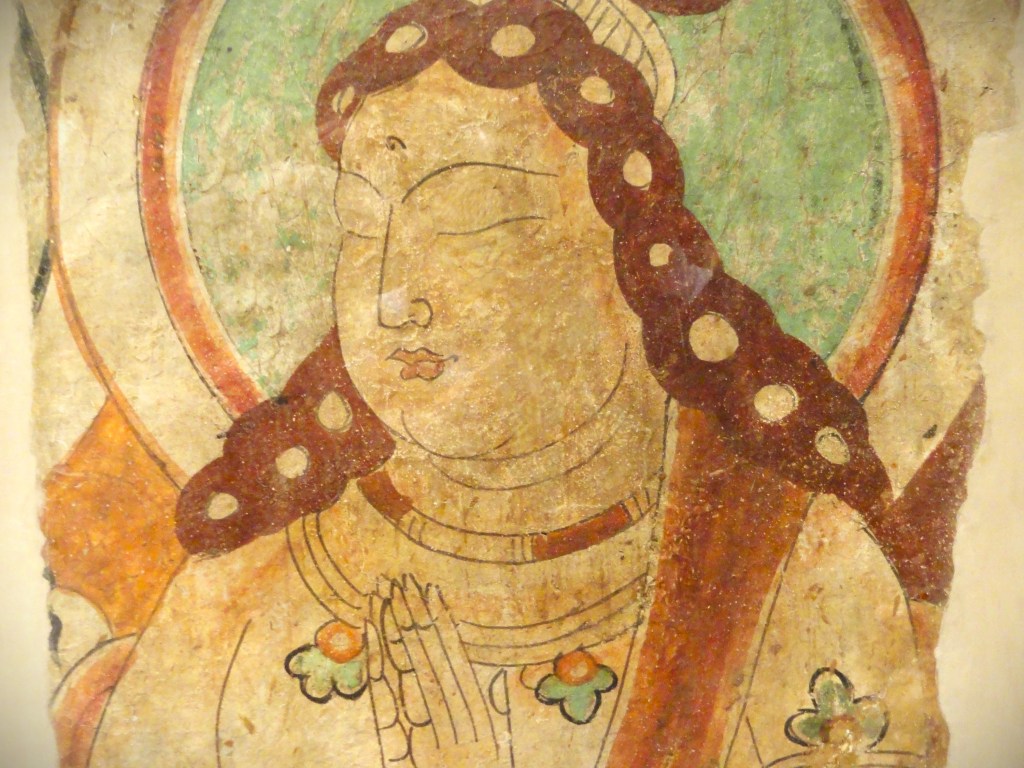
Various ancient Greek authors and poets, such as Arrian of Nicomedia, Diodorus Siculus, and Nonnus of Panopolis wrote about Dionysos’s journey to India. Dionysos was struck with madness by Hera and left to err through Asia. He conquered various Asian cities, such as Nysa in the Indus valley, and finally returned to Greece with his host. Euripides depicted his return to Thebes and the gift of madness he brings along in one of his most famous plays, the Bacchae. Dionysos’s triumphant and mystical return to Greece marks the beginning of the Dionysian Mysteries, those secret rites that determined, not only religious life in late antiquity, but the West’s religious, mythological, and theological sensibility.
Dionysos’s coming from India may be seen as the archetypal expression of the Western idea that salvation comes from a fantasized, mythical orient. Ancient Greeks, early Christians, late antique theologians thought that if some final eschatological, soteriological, or philosophical revelation must happen, it can only come from the East. The East is the origin of mysteries, the religious answer to the rationalistic West, a source of oracles and divine gnosis. From the Chaldean Oracles and Pantaenus’s journey through India to Iamblichus’s treatise on Egyptian mysteries and Christian liturgy being celebrated ad orientem–Dionysian secrets are an oriental revelation.
One notable aspect of the Dionysian myth and Western orientalism is that the East invariably corresponds to the West’s expectations. What comes from the East never brings any calamity, unintelligible message, or confusion. There seems to always be a secret, preconceived bond or connection between the Western quest and Eastern knowledge. The West consistently finds final answers that correspond to the terms and ideas contained in its question. Dionysos conquers India for the Greeks, Nietzsche finds in Dionysos an ally against Apollonian rationalism, the John Lennon and George Harrison draw musical inspiration from Maharishi Mahesh Yogi’s teaching. The answer is prearranged and never fails to confirm the expectations, and transcend them.
Dionysian expectations do not necessarily appear in the shape of mystical revelations. They can be cold and rational, depending on the zeitgeist that shapes them. A disenchanting Eastern answer can be given to a disenchanted Western problem. Such is the case for a late twentieth-century and contemporary philosophical and religious phenomenon, that may be called, according to Glenn Wallis, Evan Thompson, and Bhikku Analayo, “Western Buddhism” or “Buddhist Modernism.”
Since the late twentieth century, it has become a commonplace to say that premodern metaphysics has been debunked and that we should reject it as an ideological construction of the past. Classical metaphysics can be an object of historical inquiry, but it has no relevance to contemporary philosophical problems. Plato, Aristotle, Neoplatonism, scholasticism were expressions of a time when religion and philosophy were still somehow confused. After the twentieth-century overcoming of metaphysics, proclaimed by many different continental and Anglophone philosophers, there is no way to do classical metaphysics systematically anymore. Wittgenstein, Heidegger, and other philosophers have made it impossible to go back to speculation about realms of existence beyond our language, experience, and thought.
This shift is not confined to philosophy but has a civilizational dimension. The twenty-first century is post-metaphysical because it rejects any kind of reality beyond the physis, nature. Physis is self-determined. Reality is what can be seen and touched. Speculating about anything beyond the sensible realm would be ideological and tainted by religious dogma. Human life cannot be based on such speculation. Instead, humans should seek realization in immanence, in the presence of the world. Premodern religions and philosophies dreamed about ascetical elevation to spiritual realities–but that kind of Weltflucht, as Max Weber calls it, is pointless. Humanity thrives in the immanence of its own nature, and not in some element beyond that nature. This is why philosophers should focus on ethics, science, and societal problems, rather than on self-generated, abstract problems.
But it is difficult to overcome an ancient tradition that has brought about so many influential religious and philosophical thinkers, and to replace those thinkers with the cold and down-to-earth message of capitalist self-help and self-realization through physical, consumable means. There is a need for an Eastern prophet and divine harbinger of post-metaphysicism. Some Dionysian figure has to declare that metaphysics is dead, that we have killed it, and that the Orient validates the new philosophy of neoliberal materialism.
Enters the Western Buddha, the Buddha who was born in 1960s San Francisco, who convinced the disenchanted American youth that evangelical Christianity is at its end, who declared the new divinity to exist within oneself, who spoke Alan Watts’s language–the philosopher’s Buddha.
That Buddha had passed through different places before emerging in the US. His arrival was prepared by British-educated scholars–unintentional forerunners, who certainly did not aim to serve the aim they ended up serving–such as K. N. Jayatilleke and David Kalupahana. These scholars applied the methodology of analytical philosophy to Buddhist texts. Suddenly, many obscure passages in these texts made sense. The Buddha was arguing against the metaphysical fallacies of his Brahminical opponents in the same way as Ludwig Wittgenstein sought to dispel the linguistic illusions brought about by classical metaphysics. The Buddha’s main philosophical tool was skepticism. Unlike many other philosophical traditions, his aim was not to come up with a new doctrine or a system of ideas. Rather, he sought to show that our epistemological apparatus does not have ultimate validity. We don’t have access to what things really are. Our modes of knowing and experiencing are self-referential and cannot be used to formulate theses about reality. The Buddha has dissolved the very principle of metaphysics, and accordingly, his approach may be understood as the very contrary of what Western philosophers have been doing since Plato.
As a dispeller of metaphysics and herald of post-metaphysicism, the Buddha brought a positive answer to the American quest for spirituality without religion. He was followed by Nāgārjuna, who proved Wittgenstein to be right in that our language does not point to anything real, and Vasubandhu, who, as an epistemological idealist (but not an ontological idealist, for that would entail metaphysical views), teaches us that we should not worry about what lies beyond our perception of the world. Buddhist post-metaphysicism is the oriental, Dionysian answer to the Western quest for truth–and by chance, the truth it teaches coincides with the neoliberal, capitalist, individualist, North American, spiritual-but-not-religious, dogmatically uncommitted, here-and-now premises of the question. Coincidentally, the Dionysian Buddha is the Buddha of Western Buddhists.
This Dionysian Buddha has, in a certain way, come as a triumphant. Looking at popular Anglophone scholarship on Buddhist philosophy–Jay Garfield, Jan Westerhoff, Marc Siderits, Graham Priest, Dan Lusthaus, Jonathan Gold, Sonam Kachru–one would search in vain for references to texts, periods, and cultures that could potentially cast doubt on the post-metaphysical paradigm. Ancient philosophy, scholasticism, and early modern philosophy does not exist amidst Western Buddhist philosophers. The older generation of Buddhologists trained in classics–Lamotte, de Jong, Frauwallner–left the stage to make place for joyfully anhistorical scholarship, that takes it for granted that Buddhist philosophy is the very contrary of what Western philosophers have been doing for a long time. Buddhist philosophy undoubtedly supports the North American interest in cognitive science, epistemology, logic, philosophy of science, self-help, and well-being, and it is a powerful instrument against the Platonic-Christian tradition of empty, intellectualistic speculation about ultimate reality. There is so little room to doubt this alliance between North American and Buddhist post-metaphysicism that nobody could possibly feel encouraged to call the legitimacy of this alliance in question.
The historical evidence is at hand: depictions of Herakles Vajrapani, Indian Buddhist sculptures in Egypt, Plotinus’s Buddhism, the infinite parallelisms between Sanskrit and Greek metaphysical terminologies, Buddhist monks from Greece, the emphasis on meditation/theoria, the ontological unreality of corporeal reality, and the intellectual ascent to ultimate reality in both traditions, and so forth. But the Dionysian Buddha who came to dispel metaphysics came as a triumphant, against whom even history cannot make a case. Western Buddhist philosophy has incorporated the paradigm of North American academic philosophy to such a degree that there can’t be any hope for the traditions that North American academic philosophy has ousted–such as Platonic metaphysics–to become an object of interest and intercultural dialogue again. For such a revolution, we may need to wait for the next Dionysian avatar to come from the Indus valley. Or abandon Dionysian expectations altogether, and accept that the perennial expectation for the East to confirm Western paradigms and lifestyles needs to be given up.
 Fetch the Pliers
Leave a comment