
A society’s mind, like that of an individual, tends to operate on two different levels. One is the level of preoccupation about acute, urgent issues–issues such as economical injustice, social tensions, or more generally, issues that generate contestation and incentivize political groups. These are the issues about which people get upset, and that determine the course of history.
The other level is that of the unconscious presuppositions on which a society relies, but that it does not question or consider as an object of concern. These presuppositions often reflect issues and struggles from the past, with which society had to deal at a certain point in history, and whose overcoming has shaped the narrative of its constitution. As parts of such a narrative, these issues lose their urgency, and instead turn into ideas and concepts about what is right and good, and what should be collectively condemned. Such is the case, for example, for political shifts and the overpowering of governments. The overpowering turns into a narrative through which the new system recounts its own history. The narrative then turns into subconscious ideology, and ideology shapes and determines what a society considers to be just and unjust. A certain liberal democracy will only accept liberal democracy as an ideal political model. To a certain theocracy, its own religious narrative will be the best and accomplished form of a human community.
These two levels are often marked by a stark and disconcerting contrast. A society may consciously fight against forms of acute injustice, but unconsciously uphold other forms of injustice. In the 1950s and 60s for example, after the US had liberated Europe from Nazism and rehabilitated the ideas of democracy and rule of law, the American political and social model appeared like the consummate form of democracy. However, while this appearance influenced the perception of the US on the outside, it conflicted with the violent forms of racism that characterized the American society on the inside. American society was marked by a crude form of segregation, and for a long time it refused to address this phenomenon, despite its own key role as a guardian of democratic values. The US were able to solve the urgent problem of European fascism but remained indifferent to the consequences of its own structural problems.
But while in this case, the dominating narrative has been actively criticized by certain political and intellectual groups, there are other cases in which a certain society’s preconceptions have taken such deep roots, and assumed such a fundamental, constructive role in that society, that they cannot coexist with any different, alternative narrative. In these cases, the collective acceptance of certain ideas and the collective repudiation of certain other ideas are so unanimous that they leave no room for any attempt to analyze the preconceptions in which these collective acts are grounded. Collective repudiation in particular can be so absolute that any attempt to interpret it will be seen as complicit in the repudiated thing. The attempt will be covered with an irrational, almost religious taboo.
Anti-Catholicism is, in the twenty-first century, one of the most striking cases of this deeply-rooted, immemorial, unquestionable collective repudiation.
Talking about anti-Catholicism is only possible from a distance: One must always keep an eye on the imminent danger of becoming complicit in the Catholic mind; one can speak about it sociologically, or in terms of group dynamics, but only with a strong commitment to religious disengagement. One must always keep the assumption in mind that the decline of Catholicism is self-inflicted and a product of Catholic participation in oppression, murder, and other crimes. Hence, one can only speak about anti-Catholicism as one would speak about the necessity to treat convicted criminals humanly: with a note of condescending pity. The distance between the observer and the anti-Catholic phenomenon must never be bridged.
This unconscious, ultimate “acceptable prejudice” (P. Jenkins) is the stratified, crystallized result of a historical process dating back to different forms of Protestant anti-Catholicism in the sixteenth century, to the French, revolutionary anti-clericalism in the eighteenth century, to the secularist policies of Joseph II in the nineteenth century, and to the revival of Puritan and Calvinist ideas in twentieth-century North American fundamentalist evangelical circles. The narrative established through this historical process has turned into a system of ideas, and this system of ideas has become dominant in Western, both American and European societies. Today, anti-Catholicism is the standard approach to Catholicism. One can speak about Catholicism–as if its essence were plainly visible–only in negative terms.
Within the societies impacted by anti-Catholicism and its narrative, it is acceptable to talk about Catholicism in essentialist, absolute terms: The Catholic church is a pedophile ring with misogynistic and misanthropic tendencies, a Pharisaic cult that has corrupted Christianity and turned it into a sectarian boys club for elderly, misguided perverts; it is, among all religions and institutions, the one religion and institution that has aggressively and mindlessly fought against all other systems of belief and religious practices to destroy them; that has promoted injustice and oppression; that has acted as the main cause for colonization and the destruction of indigenous cultures; that has institutionally legitimized the murder of innocent people; that has supported totalitarian political systems; that is systematically racist and homophobic; that is the main cause of the problems facing Western culture at a global scale.
While these ideas sometimes emerge from the unconscious and are voiced in public discourse, they always remain at the level of preconceptions, and are never confronted with the question whether they contain the full reality of what Catholicism is–precisely because their main appeal is not to a factual state of reality, but to a certain essentializing construction or representation of reality. Or to put it differently: While these ideas are grounded in indisputable facts in the history of Christianity, they are never put in the perspective of the question whether such stereotypes can reasonably be accepted as being fully expressive of the reality of Catholicism.
This gives rise to the question: What is Catholicism, beyond these abstractions?
Catholicism exists as a religious confession professed by individuals and practiced as a community. For a Catholic, the question of Catholicism and of its reality is not a historical or institutional question, but a question of personal and communal meaning. A Catholic does not engage, in the exercise of that meaning-giving practice, with the responsibility for what another Catholic or the Catholic institution do or did in the past. A Catholic is not complicit in personal or institutional acts or happenings that do not concern him or her, and that he or her has not caused. Catholicism, as the reality shared by Catholics, exists, not in past, historical happenings or in present crimes committed by individuals, but in the unifying, social and religious dynamic of its members.
Admittedly, such a dynamic does not offer a clearly delineated answer to the question of what Catholicism is. But what it shows is precisely that the answer to this question is problematic and does not allow such a uniform answer. Identifying Catholicism with one of its historical or present problems is conceptually unsound–the Catholic institution, the Catholic Church, or more generally, religion as such, are not reducible to any such abstraction.
The willingness of Western societies in the twenty-first century to indulge in this reduction–to call the pope a pedophile, a priest a colonial criminal, Catholics bigots–is so striking because these societies are mostly committed to uncovering and eliminating essentialist preconceptions. Critical theory and postcolonial studies have contributed to making these preconceptions visible and to highlight their presence even in systems that aspire to overcome them. The twenty-first century is characterized by the openness to transfer the content of the second, unconscious level of societies’ thinking into the first level of clear and objective consciousness. But it allows for a form of exceptionalism to exist–and exceptionalism that keeps anti-Catholicism from becoming an object of critical inquiry.
While Western societies are ready to address the problem of Islamophobia and to insist on the difference between vague accusations of religious terrorism on the one hand, and the reality of practiced Islam on the other hand, while other societies are open to the richness of religions outside their own cultural horizon, and while there is a sustained effort, on the part of younger generations, to seek education in spiritual traditions, Catholicism does not participate in this new paradigm. Catholicism is repudiated because the distinction between its historical or political manifestations and its concrete, contemporary reality in the practice of individuals and communities is not admitted. While it would justly be seen as objectionable to relate present-day Muslim religiosity to the Muslim conquest of North Africa and the Near East, to the destruction of religious heritage, for example, in Ethiopia, or to the conquest of Constantinople–and such relations do no objectively exist–it is not seen as objectionable to repudiate Catholicism because of the crusades or the inquisition. While violent responses to the discovery of new evidence for historical conflicts or crimes would be deemed immoral in the case of certain religions, the burning of Catholic churches, as for example in Canada, has escaped public attention. The very attempt to bring it to public attention would be susceptible of provoking an outcry and sympathies with the arsonist acts–for the Catholic church has deserved what happens to it.
This exceptionalism raises the question: Is there any explanation for the inextinguishable nature of anti-Catholicism?
There is no causal or rational explanation. Inquisition, the crusades, colonization etc. are insufficient to explain the visceral, almost pathological nature of anti-Catholicism. We have to go deeper into its dynamics and, most importantly, into the stabilizing function that anti-Catholicism assumes in Western societies. In fact, rather than being a result or a finality, anti-Catholicism appears like a function or a tool. It supports something that is different from itself, and it cannot be abandoned, lest the thing that it stabilizes and supports becomes questionable.
What, then, is the function of anti-Catholicism?
Anti-Catholicism is most prominent in societies in which the Catholic church was the dominant religious institution until the twentieth century, as well as in societies marked by Reformed religious and political ideas. These societies are now determined by a strong liberal and secularist paradigm. The secularist paradigm is not inherently anti-Catholic, because it does not include any negative charge against any confession in particular. Rather, as of the twenty-first century, it constitutes the only viable paradigm and model to build multicultural societies. Secularism itself is not an ideology: it does not suppress religion but is a way of attenuating the conflicting potential of religion. Secularism itself is not a cause of anti-Catholicism; rather, one could argue that secularism is indirectly derived from Catholic, universalist ideas.
Secularism turns into an ideology when it is appropriated by liberalism as a reason to suppress religious discourse, education, and ideas from society, and to posit these things as a problem and as a threat. Liberalism is threatened by the liberating potential of religion, for religion places spiritual liberation through moral and personal purification above the obligations and rights of the liberal subject. Religion is more than consumption and materialistic self-determination; its goal is not social and immanent but universal and transcendent. Thus, liberalism sees religion as a hostile counter-paradigm, and as based on a vision of the human being that contradicts its own. Thus, it assumes anti-Catholicism to protect itself.
Western, ideologically secularist liberalism is threatened by the fear of transcendence. The threat is so menacing that liberal ideology gives up its appeal to rationality. It becomes incapable of formulating a response to protect its own ideas and seeks for other ways to defend itself. To respond to the threat of transcendence, it produces a pseudo-transcendent reaction, a figment of religion that allows it to covertly skip its usual appeal to rationality while nevertheless pretending to fight a rational combat against a depraved enemy. This figment of transcendent justification is anti-Catholicism.
Anti-Catholicism is liberalism’s own religious response to the threat of transcendence. Liberalism is obscurely aware of the necessity of spiritual purification through transcendence, and it fears, in Catholicism, the presence of this necessity. Hence, liberalism produces and exacerbates anti-Catholicism to banish and invisibilize that necessity, like a scapegoat. And this exacerbation works so well because it can utilize various historical facts as pretexts. Catholicism is a scam, religion doesn’t work, the quest for transcendent truth is meaningless and inhibits the human desires to which only Western liberalism can respond. Priests are pedophile perverts–they pretend that they seek purification, but that purification is an illusion. Only liberalism can bring personal, biological, consumable, sexual satisfaction. Catholicism pretends that the liberal subject cannot quench its spiritual thirst–but it turns out that such thirst is unreal, and that in reality, it is Catholicism that fails to respond to the needs of the human person.
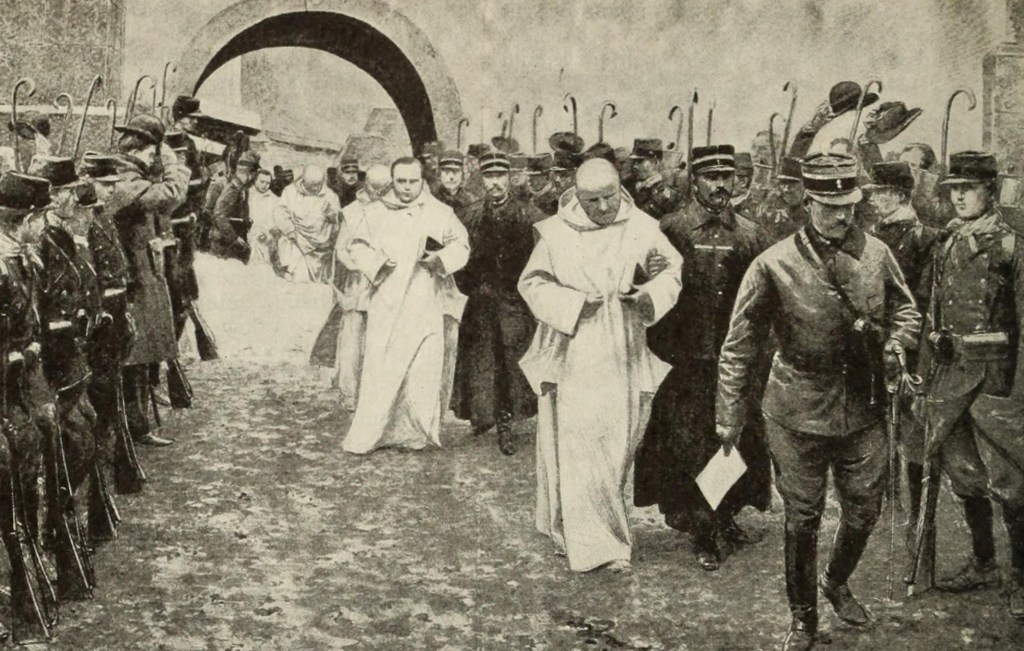
The public exacerbation of anti-Catholicism became visible at various points in modern history. In 1880 and 1901 for example, the French government adopted anti-clerical laws that made it possible to expulse religious, even contemplative orders. In 1903, the Carthusian monks were expulsed, with the support of the army and police forces, from their monastery, the Grande Chartreuse in Saint-Pierre-de-Chartreuse. This and the other hundreds of expulsions were the consequence of the anticlerical rhetoric that had pervaded French public and political discourse for decades. This rhetoric was fueled by caricatures with vulgar and obscene accusations against the clergy as well as religious orders.


This vulgarity makes it evident that French anti-clericalism and European anti-Catholicism are not so much concerned with real political or ideological issues, but with the vital, primitive threat posed by the idea of clerical and monastic, ascetic life. Monasticism is the archetypal enemy of liberalism. It questions the anthropology postulated by the principles of liberal society. The liberal subject cannot reasonably be attracted to the idea of giving up comfort, financial power, material wealth, and the freedom to choose between different, consumable options at all levels of his or her life. Therefore, liberalism must cultivate the idea that monasticism is a scam and that religious life is just a farce. In reality, monks and nuns are depraved, greedy, insatiable monsters.
It is only by entertaining this profound, almost psychotic conviction about the failure of the Catholic program that Western liberalism can uphold its own program and its struggle against ideas such as religious reformation and life beyond physical and social limitations. But paradoxically, anti-Catholicism ends up, in its struggle against transcendence, resembling the religion that it wants to repress. Like Catholics, anti-Catholics accept that a personified enemy, the Catholic Church, exists, and describe this enemy as a metaphysical entity, in abstract, absolute notions. And like Catholics practicing Eucharistic communion to participate in the passion and resurrection of Christ, anti-Catholics practice some kind of inverted, liturgical anti-Eucharist, by celebrating the death and passion of Catholicism, by devouring its embodied reality, and by feeding off its dispersed fragments. In its fear and anger about the threat of transcendence, anti-Catholicism mimics the dying being whose death it wished for, so as to ridicule it and make its return impossible.
Thus, the resilience of anti-Catholicism can be explained by the expurgatory function that it assumes in Western liberal societies. Anti-Catholicism is not just a random element of liberal discourse. It is liberalism’s reaction to the presence of Catholic religiosity in its organism. By concentrating the contempt emanating from its limbs and organs on Catholicism, a liberal society becomes able to eject Catholicism from that organism, and purge itself from its desire for religious and spiritual expansion.
A notable consequence of this liberal expurgation is that the Western interest in religions outside of its own cultural realm and its hope to find non-religious answers to its religious questions there will remain, as long as anti-Catholicism is dominant, tainted by anti-Catholic bias. The West justifies its interest in non-Western religious and spiritual traditions, such as East Asian Buddhism, meditation, yoga, precisely by pointing out the deceitfulness and false aspirations to transcendence of Christianity and Catholicism, and by approaching non-Western religions under the assumption that these religions will be fundamentally different from the repudiated Christian stereotype.
This poses a dangers insofar as anti-Catholicism might turn into the new form of Western universalism. The West will extend its expurgatory bias, in its struggle to purge itself from Catholicism, to a global level. Wherever it will find religion, it will praise that religion as being a healthy, responsible alternative to Catholicism.
Paradoxically, anti-Catholicism, which is grounded in the rejection of Catholicism’s alleged, colonial universalism, might turn out to be the new universalist aspiration of the West.
 Fetch the Pliers
Leave a comment