
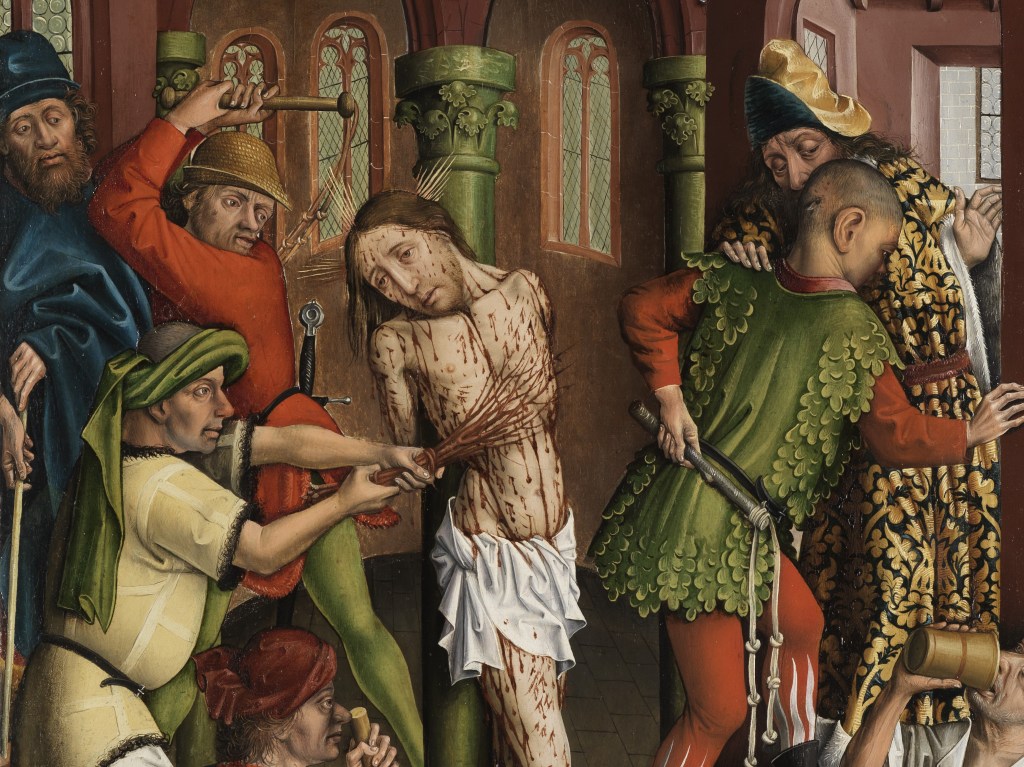
Qui autem te per contemtum mundanorum et carnis mortificationem sequuntur, vere sapientes esse cognoscuntur, quia de vanitate ad veritatem, et de carne ad spiritum transferuntur.
Those who follow you by loathing worldly goods and mortifying their flesh will be known as wise, because they pass from vanity to truth, from the flesh to the spirit.
Thomas a Kempis, cap. XXXIV, 2 in libro tertio de imitatione Christi
Religion is invisible. What it deals with and what it produces is unrelated to anything that can be experienced or conceived. Its objects are non-assessable and non-verifiable. This characteristic makes it possible for the very nature religion to be profoundly altered and to become completely different without attracting notice. Practicing religion can, at a certain time, exist as a certain thing, and be completely different from that thing at a different time. It can be abstract monotheism at one moment and pure ritualism or magic at the next. In the light of this contingency, the very notion of “religion” can become equivocal.
In the twenty-first century, the West sees in religion a choice. Religion is what one chooses on the basis of one’s aspirations and quest for meaning. Religion provides the means to discover the unity of the constitutive elements of one’s life, and to understand that there is an invisible center of gravity around which events, people, and things gravitates. One just has to find the right tradition and the appropriate vocabulary to uncover that center of gravity within oneself. Religion proceeds through some kind of private investigation, where one reads, reflects on one’s own needs, and keeps searching until the right book, conversation, or experience arises.
The dynamic of this quest is essentially proactive. One has to assume an observer’s position and pay attention to one’s existence, looking at it through the lens of this or that religious terminology, and measuring the effects that the practice of the respective religion has on one’s life. The choice of a religion depends on the depth and the continuity of these effects–they are the criteria by which a choice is made. One’s religion is the ideology that suspends one’s existential restlessness.
However, looking at this mechanism, one cannot but feel disconcerted by the presence, at the center of the dynamic of religion, of criteria that depend on feeling of well-being and comfort. The quest for religious truth seems to involve the idea that the choice that one can make conforms to one’s intimate emotional and intellectual responses to the practices proposed by a certain religion. The criteria for religion lie in one’s own experience of religion.
The disconcerting element is that throughout different historical stages, religion had its center, not in any proactive, spiritual quest and or in experiences that one might have along the way, but in the eschatological, metaphysical, and mystical vanishing point in which any experience or personal inclination is absorbed and brought to dissolution. Religion was, throughout premodern times, a call to a higher-order reality; but in the twenty-first century, it is driven by the quest for meaning-giving, personal experience. This transformation is so profound that one could say that religion has turned into the contrary of what it was before. Before, it appealed to the necessary overcoming of finitude–but now, it serves to find a way to inhabit that finitude without proposing anything beyond finitude.
One way to conceptualize this inversion is to look at the way that premodern religions approached personal existence and experience, and to compare them to the way that these same elements are dealt with today.
From patristic times on, Christian theologians and theorists of contemplation saw in the Platonic idea of the practice of death, meditatio mortis, μελέτη θανάτου, an ideal of religious life. The practice of death, or mortification, consists in a rejection of bodily comfort and in a sustained effort to keep one’s biological existence in the presence of death continuously. If the present body is marked by concupiscence and cannot participate, in its material form, in redemption, but must make way for the spiritual body, it must be inhabited as if it were a provisional dwelling–a dwelling of which one must take care, however, lest it is overgrown with weeds and cannot even function provisionally anymore. One must keep the dwelling in an unencumbered state, ready to be left at any moment.
And so, too, the body must be reduced to its most diminished form, to the most minimal form of what it realistically can be. It must be brought to the verge of non-existence, so that it mirrors the immanent presence of death. This is how the early theorists of monastic life, the Desert Fathers, John Cassian, Benedict of Nursia, thought of religious life: One must make one’s own existence stand before death everyday, mortem cotidie ante oculos suspectam habere (Rule of saint Benedict 4,47) and never seek for a moment of relief from death’s presence. The body must wither to allow for the spirit to live.
The practice of placing one’s existence in the presence of death, of making it pass through the suffering of destitution to attain what lies beyond death, may be called, with a Platonic-Christian term, mortification. Mortification represents the very essence of religious life. It is the turning point at which immanence is converted to transcendence, and where the the meaningfulness of the categories in which life usually unfolds is uprooted. The unbearable presence of hunger, pain, soreness, hopelessness, and extenuation is lifted and yields to a new presence, in the light of which these things seem to loose their grip on reality. Mortification is a way of paving the way for the arrival of that presence.
Looking at the function of mortification, one can see that it points to something incommensurate with the criteria governing the choice of a religious belonging that characterizes the twenty-first century. From the standpoint of mortification as an ascetic exercise of self-restriction, the very idea that religion may provide a feeling of existential fullness appears highly problematic. If religion leads from an unreal “here and now” to an eminently real and timeless “there,” it is difficult to see how any attempt to stabilize the “here and now” could be made consonant with religion.
It is unsettling to see that the incentive for religious practice has shifted from the crushing eruption of transcendence in finitude–from the feeling that the transcendent reality of the Absolute is everything, and that one’s life is like a projection of that reality, waiting to return to its source–to the choice of a tool to make that existence more habitable and agreeable.
The shift is of such depth that it seems to reorient the very social dynamics by which religion is determined. Today, any religious quest in the West begins with a sense of dissatisfaction about the insufficiency and lack of depth of one’s life. Become aware of that dissatisfaction, people in the West start exploring religious traditions that seem to deal, not with the urgency or imminence of an eschatological event, but with ways to appease the feeling that one’s everyday life is becoming dull. The religious seeker goes about wondering whether he or she should become a Zen Buddhist or an Advaita Vedāntin, measuring, at each step, how much dullness their new interest cuts away, and how their inner life resonates with the new environment. Thus, a starting point for religious practice located in one’s existential experience leads, not to a Schleiermachian feeling of dependence, but to an increasing desire to find the source of existence in one’s own convictions and emotions.
In the last stages of this shift, the new religious paradigm supersedes the old one through mockery. Today, one can only write and think about monastic mortification ironically and condescendingly. Mortification is deemed to be a pathological expression of the dysfunctional dynamics of premodern societies. Mortification can ultimately be explained through social, political, economical, and psychological categories. It is the sign of a stage in human history when religion had not yet attained its purified form. Now, as we can walk into any library to buy a book about the tradition that speaks to our body and soul, that form is thought to have arrived.
But what if, in Paul’s words, one dies if one lives after the flesh? What if death awaits in the final realization that “the world is death” (κόσμος θάνατος) as Symeon the New Theologian writes, and that life transcends it? One would regret to have used religion to find consolation in a world that is, in reality, death.
 Fetch the Pliers
Leave a comment