
In the twenty-first century, it has become common again—in the US as much as in India—to invoke religious reasons for political decisions, and to appeal to sacred scriptures or dogma as sources of secular authority. Religion is seen as a framework constituted of immediately applicable, non-problematic rules: prohibitions for food and sexuality, imposed social hierarchies, exclusionary and segregative communal practices. These rules leave so little room for interpretation that they do not require any intervention of the human intellect. Rather, intellectual curiosity is an obstacle to religion. What is written or stated must be put into execution without any question.
The deeper reason for this conviction is that religious, “divine” authority is not seen as a problem that requires investigation and sustained conceptual efforts, but as something that works just like human authority. God commands something—in human language, and easily translatable into guidelines for human life—and humans are held to conform. There is no distinction between the divine, normative order and the order of human intelligence and agency.
The temptation to confuse these two orders, divine and human, is the most basic trait of what may be called anti-intellectualism.
Anti-intellectualism is the conviction that divine agency and normativity relates to human actions and norms in an immediate, non-problematic way, and that questioning this immediacy through intellectual means is illicit or an act of arrogance. When some divine instance appears to command a certain thing through scriptures, human representation, or other sources of human authority, that thing cannot be questioned or investigated intellectually, but it must be carried out succinctly and without hesitation. A woman has to wear a mantilla in church because Paul says so, communion must be received on the tongue because a council says so, a certain food is impure because a certain passage in the Old Testament says so.
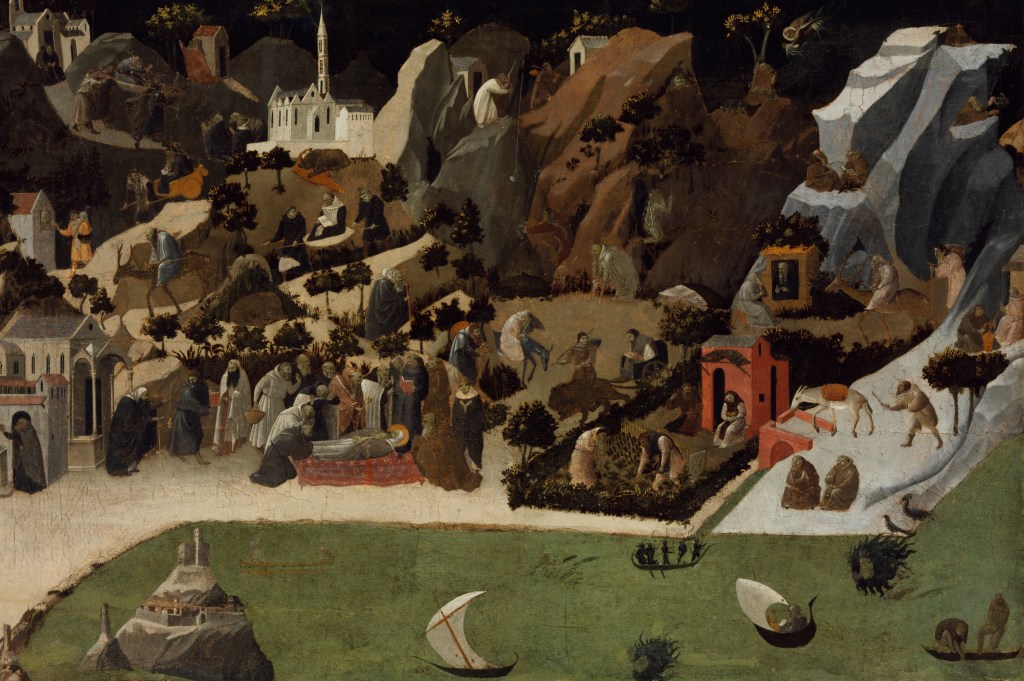
There is an event in the history of early Christianity that illustrates anti-intellectualism in the most palpable way. In the fourth and fifth centuries, a theological conflict opposed two groups of monks in Egypt. One group adhered to Origen’s theology and vision of divine being. Origen thought of God as a transcendent, self-transparent Mind that is incommensurate with any human representation. He based this idea on the Platonic metaphysical tradition that became prominent among Christians through the Jewish philosopher Philo of Alexandria. The other group, the anthropomorphists, supported the idea that God closely resembles a human person, and that the human attributes described in the Old Testament apply to him literally. They thought that God was a person with a body, emotions, and thoughts.
The anthropomorphist position is perhaps the purest historical realization of religious anti-intellectualism. Anthropomorphists promoted a literalist interpretation of scripture and reduced God to the categories of human existence. They rejected Origen’s theology as intellectualism and considered theological speculation to be something inherently objectionable and bad.
Origen’s theology was attacked in the fourth and condemned in the sixth century, and a surprisingly large number of theologians supported official anti-Origenism. Jerome–the translator of the Bible, Epiphanius of Salamis, Methodius of Olympus, and other thinkers thought that intellectual audacity must always yield to the norms of what they thought to be orthodoxy. They were anti-intellectualists because they wanted scripture and theology to be straightforward, rigid, and eternally self-identical.
The history of Christianity may be interpreted according to the paradigm of this early conflict. Some theological periods and streams were deeply reactionary and anti-intellectualist, such as the Renaissance Catholicism that killed Giordano Bruno, or seventeenth-century New England Calvinism that made people lynch and murder women. Other period and schools were theologically audacious and paved the way for speculation about God and scriptures: medieval scholasticism, nineteenth-century German Protestant theology, twentieth-century liberal theology.
Anti-intellectualism is not a punctual or precisely identifiable historical phenomenon. It is one of the fundamental principles of religious dynamics. It remains present throughout religious histories in its latent form, as a temptation to overrule intellect and impose a certain religious norm derived from human authority or a literalist interpretation of scripture. Theologians sometimes oppose and denounce this temptation, but often give in to it and fully embrace it. Political theology, fundamentalism, traditionalism, religious terrorism, rigorism are different historical manifestations of the willingness to consider a certain finite, restricted representation of the absolute as the absolute itself, and thus, realizations of anti-intellectualism.
Anti-intellectualism can present systemic traits and pervade structures overarching the history of a certain institution. One example of such systemic anti-intellectualism can be found in certain interpretations of the Christian, monastic notion of “obedience.” The novice’s obedience to his or her spiritual master pervades the earliest strata of Christian monastic literature. The Saying of the Desert Fathers abound in passages that praise the novice who obeys even the most abusive spiritual master. Even when a master is wrong in every possible regard, and does harm to his novice, the novice must not dare to judge the master or doubt his guidance. Novices should give up their faculty to judge and their feeling of what is right and what is wrong. The Rule of Saint Benedict, that has determined monastic life in the Western world, is adamant, too, in its emphasis on obedience. Obedience is the very principle of the relation between a novice and his master. The first word of the rule, Ausculta, does not just mean “hear!”. Rather, it aims to echo the relation between an abbot and his community, or a novice master and his novices. These relations are relations of vertical obedience, in which the monk or novice is held to “hear,” that is, to accept the words that are given to him. The intellect should not stand in the way of this acceptance.
It should be noted that the Sayings stand under the direct influence of the Origenist crises in Egypt and Palestine. They can be historically explained by the emphasis that the dominant theologians, who stood under the influence of episcopal and imperial politics, placed on the need to refrain from intellectual speculation. The aim of monastic life, they thought, should not be seen in the construction of lofty private theologies and in the goal of becoming a mystical master, but in the sequella Christi as in the concrete relationship to one’s novice master.
This pillar of monastic spirituality has deeply influenced the structures of Christian spirituality and religion in general. The desire to promote orthodoxy, literalism, and tradition easily allies itself with the desire to restrict the personal interests, speculation, and theoretical audacity of the intellectual elite. This alliance has reemerged at different points in the history of Christianity, and always threatens to reemerge again. When questions about sexuality, healthcare, dogma etc. are raised, the temptation to argue from the standpoint of an imagined tradition or authority is almost inevitable. But such arguments cannot be presented as self-evident, for Christianity has, as many other religions, not begun as a tradition, but as an attempt to overcome tradition. Despite the lingering presence of anti-intellectualism throughout religious history, anti-intellectualism is not built in Christianity nor in any other religion.
In the twenty-first century, we are facing a troubling resurgence of anti-intellectualism. This resurgence is fueled by a dangerous dialectic: the dialectic between a growing and unmasked hostility against education on the anti-intellectualist side, and, on the secular side, a willingness to project that hostility into religion itself. One side exasperates the other, reenforces stereotypes, and makes the conflict become inextricable. Anti-intellectualists present religion as a haven of cultural conservatism and tradition, and secular thinkers and scholars give in to that identification. This dialectic leads to an almost uncontrollable fusion between anti-intellectualism with religion, equally supported by advocates and opponents.
The only convincing objection to anti-intellectualism lies in the study of the history of religion. When fundamentalists point out that religious scriptures condemn or prohibit a certain thing, the only historically and theologically warrantable response to such a claim is that condemnations and prohibitions spring from the historical context in which religious scriptures are established, that most classical, exegetical traditions do not promote a literalistic but an allegorical approach to scripture, and that it is by no means justifiable to derive religious norms from the translation of highly problematic, historical documents. The value of such documents does not lie in their letter but in their spirit.
However, such an objection requires that the enemies of anti-intellectualism do not simply accept anti-intellectualist accounts of religion, but dissociate religion from anti-intellectualism through scholarly means. This dissociation is not an easy task because of the prominent, fundamental role that anti-intellectualism plays in the history of religion. But deconstructing anti-intellectualism appears as the only viable alternative to the impossible and implausible task of deconstructing religion as such.

 Fetch the Pliers
Leave a comment